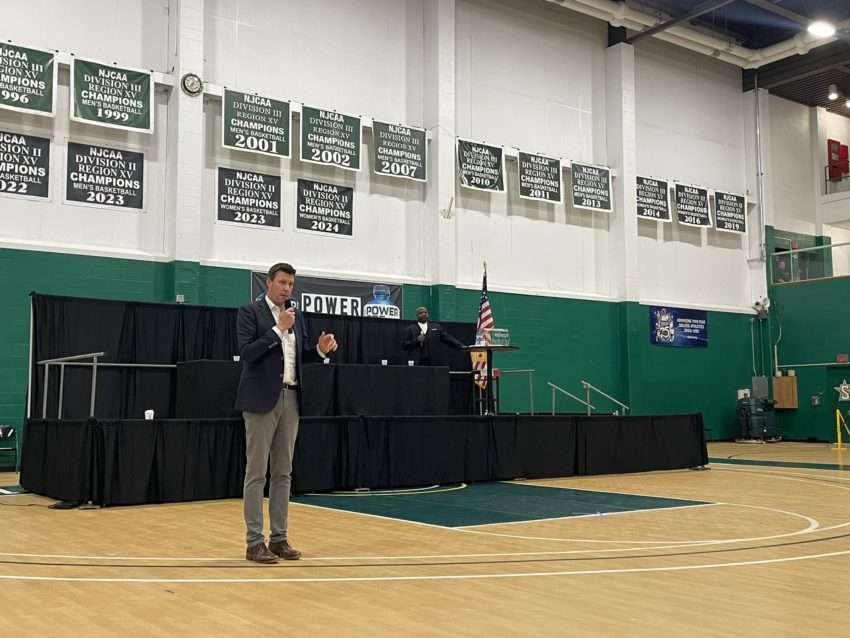
New York 19th District Congressmember Josh Riley visited Sullivan County on Monday evening to discuss how to keep healthcare close to home.
Riley criticized lawmakers backing One Big Beautiful Bill’s healthcare cuts as the federal government enters its second week of a government shutdown.
“In Washington, a whole bunch of politicians are pushing legislation that is gonna take a trillion dollars out of the public health system, all to give tax breaks to Wall Street and folks who don’t need it,” said Riley, who represents the largest congressional district in New York state.
More than 100 people attended the town hall at SUNY Sullivan in Loch Sheldrake, where Riley spoke with local healthcare and community leaders about the threats and solutions facing rural communities. Still, more than half of the seats were empty, leaving residents like Janet Davis disappointed by both the turnout and the substance of the discussion.
“I think it’s very notable that Representative Riley is trying very hard to reach across the aisle and work bipartisanly. I’m kind of skeptical about that,” said the Wurtsboro resident. “I’m all for compromise and collaboration but I’m not sure in this instance if that’s really going to be fruitful and really benefit his constituents in this particular climate.”
Here are five issues Riley discussed with local leaders.
Healthcare access in rural communities
Riley said he believed that healthcare “should be a civil right in this country, not something that’s driving corporate profits.”
He urged that he’s pushed back for months against Trump’s federal spending bill that could strip healthcare coverage for an estimated 1.5 million New Yorkers.
In August, Riley co-sponsored the Rural Hospital Stabilization Act which could provide $500 million in emergency support to rural hospitals struggling to stay open following federal spending cuts. The bill would authorize the Department of Health and Human Services to award grants of up to $5 million per hospital over five years for facility repairs and operating costs.
Attendees told Radio Catskill they were concerned about a range of healthcare threats: waning healthcare clinics in already under-resourced communities, longer distances to care, and access to reproductive healthcare in rural areas.
Steven Kelley, CEO of Ellenville Regional Hospital, said during the panel discussion that rural hospitals will be hit hardest once the federal spending bill takes effect. 70 percent of Ellenville Regional’s revenues, Kelley says, come from Medicaid and Medicare recipients.
“The hospital system is very, very vulnerable here in New York,” said Kelley. “We’ll have to figure out how we can tighten our belts and redeploy resources and get through, but this is gonna make it very difficult for a lot of struggling hospitals that are already in trouble.”
Responding to a question on how Riley is fighting for access to sexual and reproductive healthcare, Riley said he sponsored the Women’s Health Protection Act to restore the right to provide and access abortion care.
“ I think women should be able to make their own healthcare decisions, and you have a bunch of old men on the Supreme Court trying to dictate these decisions, which is unacceptable. Those are decisions that should be made between a woman and her doctor.”
Israel’s war in Gaza
Rep. Riley’s visit to Sullivan County didn’t come without some pushback. Sullivan County resident Eric Feinblatt was one of a handful of attendees who held a silent protest criticizing Riley’s AIPAC-sponsored visit to Israel in August.
“We’re here because we’re appalled by Josh Riley’s specific visit to Israel, which we think was just a propaganda campaign,” said Feinblatt. Tensions ran high when Chenango County resident Francesca Testi pushed Riley on why he hadn’t supported halting arms shipments to Israel.
“How do you trust him on healthcare if you can’t trust him to stand up to AIPAC when the really tough deals go through?” said Testi.
During the town hall, Riley called for humanitarian aid to enter Gaza, a ceasefire, and the release of all hostages but did not respond to a question on whether he would support an arms embargo.
“It seems further away than it’s ever been, but we have to come out of this with a real plan that allows Palestinians and Israelis to live side by side in peace and with security, because at the end of the day, that is all anybody wants,” said Riley.
High utility bills from NYSEG, Central Hudson
One of the key issues Riley says he has championed is pushing back against skyrocketing utility bills.
He’s taken several steps on increasing utility bills, including formally intervening as a party on behalf of ratepayers in the New York State Electric & Gas (NYSEG) rate case and introducing a bill that would stop foreign corporations from owning American utility companies. NYSEG, a Spanish-owned company, requested a rate increase that could raise average monthly bills by more than 30 percent for some customers.
“I have talked to so many folks who are making really difficult decisions about whether to pay the utility bill or pay for the groceries they need [or] pay for the back-to-school clothes that their kids need,” he said.
Immigration raids on dairy farms
As immigration raids ramp up across the country, Riley said no law enforcement officers should wear a mask. “That’s part of the relationship with the community,” he said.
He’s worried about both farm owners and farmworkers on New York’s dairy farms, where more than half of the state’s dairy farm workforce is undocumented.
“This is a sort of thing in our immigration system that I don’t see this as a Democratic issue or a Republican issue. This is just an issue of do you represent rural America and represent dairy farmers?” said Riley.
Food insecurity
Sullivan County Commissioner of Community Resources Laura Quigley said that increasing housing costs coupled with rising food insecurity has left New Yorkers especially vulnerable as county and state agencies brace for SNAP cuts.
“Just think in your head of a very fragile house of cards,” said Quigley. “We still have food deserts in this county. We have coming cuts to the SNAP program. It’s going to hurt an awful lot of people, most of whom are working or elderly.”
Riley discussed introducing the Local Farmers Feeding our Communities Act, which would infuse $200 million back into community food banks, schools, and local farms.
“That is the hard work that we have to do: rolling up our sleeves, reaching across the aisle, finding solutions to mitigate against this damage that otherwise is gonna have kids hungry, farmers struggling, and food being shipped halfway across the country when we can grow it instead in our backyard.”
Image: NY-19 Representative Josh Riley on Rural Healthcare Conversation and Town Hall on October 6 at SUNY Sullivan (Photo Credit: Kimberly Izar)
Riley pretends to care shout healthcare in his district while destroying the entire health system in Gaza. The guy is sick and evil.
What this coverage of the event leaves out is that Congressman Riley chose to leave the room rather than answer my question: Why, when 75% of the Democratic base wants us to stop sending arms to Israel, are you voting to continue those arms shipments? Who do you represent? He also ignored questions about his AIPAC-sponsored trip to Israel during the August recess, which he, not surprisingly, did not mention in his newsletter that covered his August activities. My question to my fellow Democrats is, if the $36,000+ donations he got from the pro-Israel lobby was enough to make him ignore our wishes in this case, what makes you think he’ll listen to us when the big donations are thrown at him from the insurance and pharmaceutical lobbyists?
Francesca Testi
I was extremely disappointed that this event was not zoomed and (apparently) not recorded. Riley’s district is very extensive and expansive. In my case living in Binghamton the distance and the timing (at night) would not allow me to attend in person. While I am grateful for the coverage here in Radio Catskill it is not the same as live.