Science has been making headlines, from Nobel Prizes to moons that could harbor life—and even birds that collect human artifacts. Our resident science expert Joe Johnson breaks it down.
Nobel Week: Immune System, Quantum Tunneling, and MOFs
Last week, the Royal Swedish Academy of Sciences awarded the 2025 Nobel Prizes in Physiology or Medicine, Physics, and Chemistry—each to three pioneering scientists.
Physiology and Medicine: Mary Bronkhouw, Fred Ramsdell, and Shimon Sakaguchi uncovered how the immune system is regulated. “They identified what the committee calls the security guards of the immune system, which are regulatory T cells that can actually stop the immune system from attacking normal cells,” Johnson explained. Their discovery could revolutionize treatments for autoimmune diseases and cancer.
Physics: John Clark, Michael Devaray, and John Martinez were recognized for characterizing macroscopic quantum tunneling in supercooled superconductors.
Johnson summed it up: “Quantum tunneling…was previously thought to happen only at a really small scale, but these scientists prove that it can happen at a scale that makes it useful in electronics. This is directly linked to quantum computing.”
Chemistry: Richard Robinson, Susumu Kida, and Omar Yagi invented metal-organic frameworks (MOFs). Johnson described them as “self-assembling…2 grams of one of these MOFs has the same amount of surface area as a football field.” Applications include carbon capture, precise drug delivery, environmental cleanup, and electronics.
The Nobel Prizes, created by dynamite inventor Alfred Nobel, were meant to leave a legacy beyond destruction. Johnson noted, “He woke up one morning and read his own obituary…They called him ‘the merchant of death.’ He wanted his memory to be more than that.”
Enceladus: Saturn’s Life-Friendly Moon
NASA’s Cassini mission continues to yield clues about Saturn’s icy moon, Enceladus. At 300 miles wide, the moon has a salty ocean beneath an icy shell. Tidal forces heat its interior, causing water geysers to erupt into space.
Johnson said, “They found a whole host of compounds…basically life soup. Life-friendly, yes. Not direct evidence of life, but a lot of the ingredients are there.”
Cassini’s 2015 flyby sampled a plume 30 miles away, revealing methane, ammonia, aromatic compounds, and other organic molecules—conditions similar to those that may have helped life arise on Earth.
Bearded Vultures: Nature’s Archaeologists
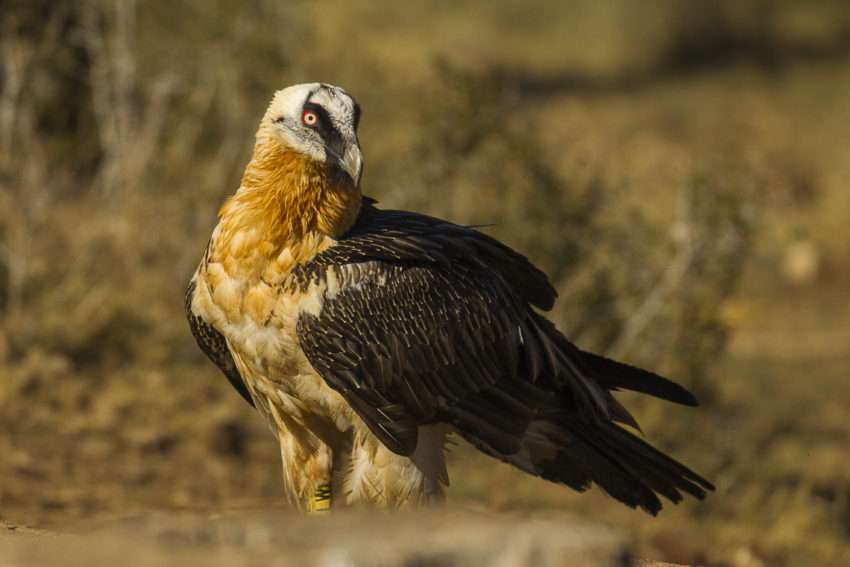
In southern Spain, bearded vultures have been creating centuries-old archives inside cliffside nests. Researchers found bones, eggshells, and nearly 200 human-made objects dating back 150 to 675 years.
Johnson said: “These birds are curating what’s happening around them. It’s like a living archive of human history alongside natural history.”
Among the finds: leather scraps, woven cloth, a medieval crossbow bolt, and even a 650-year-old sandal. The vultures appear to incorporate objects from their environment much like modern birds incorporate string or foil into nests.
Image: A bearded vulture in Spain. (Credit: Francesco Veronesi from Italy, CC BY-SA 2.0 , via Wikimedia Commons)