For ten years, Delaware Currents has been a vital voice for one of our region’s greatest natural treasures — the Delaware River and its watershed. The independent, nonprofit online publication told the story of the river from its headwaters in New York’s Catskill Mountains to the Delaware Bay, where it meets the ocean.
Founded in 2015 by veteran journalist Meg McGuire, Delaware Currents sought to “host an intelligent conversation about the river’s future,” she said, “understanding that there is a natural tug-of-war among its stakeholders and that no one person, organization, or business has all the answers.”
But after a decade of environmental reporting, Delaware Currents will cease operations on December 31, 2025. McGuire spoke with Radio Catskill’s Patricio Robayo about how it all began, the stories that mattered most, and the challenges that led to her decision to bring the project to a close.
A Solo Effort to Fill a Void
McGuire’s journey began after she left the newsroom of the Times Herald-Record in Middletown, New York. “Like so many people involved in legacy newsrooms, I lost my job,” she said. “I wanted to remain in journalism, especially environmental journalism, which was one of the places where they were really cutting reporters left, right, and center.”
When no outlets were interested in buying freelance pieces about the watershed, she took a leap of faith: “Someone suggested I reach out to the City University of New York’s Graduate School of Journalism. They were running what they called a solopreneur course — launching people into the web universe. Over six months I got lots of insight from smart people, and eventually set up Delaware Currents.”
It launched in 2015, a true one-woman operation. “When I started, I knew about writing and editing — that was my whole shtick,” McGuire recalled. “But there are two other legs to this stool — technology and fundraising — and those have never been my strong suit.”
Still, she pressed on. “It just struck me that this watershed is too important for too many people to not have its own dedicated coverage,” she said. “So that’s what I started doing.”
Finding Purpose and Funding
The early years were difficult. “For three or four years there was no funding,” she said. “I was shoring up Delaware Currents with my meager pension funds — probably not a wise financial decision.”
That changed when she discovered News Match, a national campaign that doubles small-donor contributions to nonprofit newsrooms. “For every dollar I raised from private citizens in November and December, it was matched up to a limit,” she explained. “That meant the world of difference to me. It let me last long enough to attract the attention of the William Penn Foundation.”
The foundation’s focus on watershed health helped Delaware Currents grow — but, as McGuire noted, “Foundations stay interested in something for ten years, and then they want to change their focus. When their focus shifted to Philadelphia, I realized it wasn’t smart to go back to funding this project out of my own pocket. I think I’ve provided a valuable service — but if the people who fund nonprofits like mine don’t see it or can’t fund it, then that means it’s the end of the line for this part of my life.”
Stories That Shaped a Decade
When asked which stories she’s most proud of, McGuire didn’t hesitate: “Honestly, the whole thing. But I loved combining the little and the large — profiles of individual people alongside science-based stories about the river.”
She pointed to her coverage of dissolved oxygen levels in the lower Delaware as one of her most meaningful efforts. “I started reporting on that within the first year or two,” she said. “It affected the sturgeon, which are endangered species. The EPA recently approved new regulations that will improve oxygen levels — it’s a significant win for the cleanliness of the river. That’s been ten years in the making.”
Her reporting also tackled the emerging threats of PFAS chemicals, salt contamination, and plastics pollution. “Those are not easy reads,” she admitted, “but they’re important. People need to understand the complexity of what’s flowing into their river.”
A Broader Reflection on Journalism and Change
McGuire sees Delaware Currents’ closure as part of a larger pattern in nonprofit journalism. “There’s so much good work being done,” she said. “We are sort of cutting off our nose to spite our face. I believe quite honestly that we still have a lot more work to do to get the Delaware River as clean as possible — and to prepare for flooding, droughts, and the effects of climate change.”
She reflected on the human cost of shifting priorities: “I keep thinking of families who are suddenly without a salary or health insurance. It’s remarkable — we’re making cuts without understanding the real-world impact on communities, especially those who don’t have much to begin with.”
What Comes Next
Though she’s closing this chapter, McGuire isn’t done writing. “I don’t know yet,” she admitted. “The newsletter is changing already — maybe more essays, more opinion. I know I can write, so there might be things I should write about that could help people or matter to people.”
She’s also been honored for her work — with multiple state and regional journalism awards in both New Jersey and Pennsylvania this year. “It feels like I’m going out with a bang,” she laughed. “A friend told me, ‘You worked ten years, you won the pennant, you put it on the wall, and you walk away.’ I’m aiming to do exactly that — to be proud of the work that Delaware Currents and everyone who helped me accomplished.”
As she puts it, “I’m walking into whatever the next chapter will be with my head held high.”
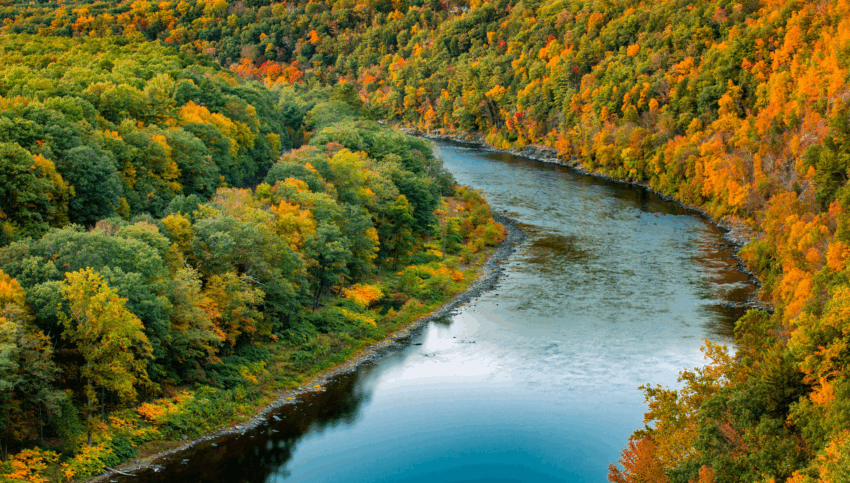
Image Credit: Upper Delaware River as it bends by Port Jervis (Photo by Ultima_Gaina
Thank you for your service, Meg. May I suggest you consider moving over to Substack where you can broaden your reach and offer subscription to fund your efforts. This is where independent journalism is thriving. Contact me if you need assistance.