This is the first story from Health on the Margins, a limited investigative series exploring the Catskills region’s fragile healthcare systems.
When the hospital called that September evening, Dorothy Sanchez said she knew.
She and her husband headed to the Garnet Health Catskills campus in Harris, New York, that Thursday, to find her son, Jonathan, still. He was pronounced dead from an overdose in September 2024 at the age of 33.
Sanchez still keeps a photo from that evening. It’s of her husband holding Jonathan’s hand after they had to identify his body. “I will never forget the cold of that moment. Not just the temperature of his skin but the cold reality of it all.”
In New York, an estimated 4,500 New Yorkers died from an overdose in 2024, according to the Centers for Disease Control and Prevention. That’s a sharp decline from what the state reported the previous year. Health advocates mark this as progress, but many families say they’re still grappling with the grief and loss that follows after an overdose.
“What do you do when you see your child just not alive anymore?” said Sanchez. “There’s no more anger. There’s no more pettiness. There’s no more who’s right. It’s just over.”
Nowhere in New York has the opioid crisis hit harder than in Sullivan County, which ranked the highest per capita overdose rate in 2022. But the following year, a shift happened: Sullivan County moved from being the highest overdose rate per capita in the state to third.
Sullivan County Health & Human Services Commissioner John Liddle says progress came from several strategies: more NARCAN distribution across communities, working with law enforcement agencies on alternative incarceration programs, and more.
But Liddle says how the county moves forward in its fight against the opioid crisis will require a change of tactics. Overdose deaths are down across the state, but what about building a life after NARCAN?
“What are we doing to bring people back to life, bring them back to their community, and really start living again? That’s where we definitely need to do better,” said Liddle.
READ: As Opioid Overdoses Decline in Sullivan County, Officials Warn Fight is Far From Over
Navigating a fractured system
Jonathan, a Monticello resident, was known in the streets as ‘Wavy,’ but to his mother, he was Sanchez’s biggest supporter.
“He had a special capacity to connect with people, like all kinds of people,” said Sanchez. “He was a mentor, the best brother, [and] the best son.”
Jonathan headed to Nyack College in his early 20s where he met someone, and the two got married. That’s when he started to experiment with drugs, Sanchez says, and when Jonathan and his former wife separated, he fell deeper into drug use.
The following years were a blur to Sanchez: she watched her son be admitted into several hospitals and held at several county jails, including Ulster County Jail, Orange County Jail, and as far as Lakeview Shock Correctional Facility in Brocktown about five hours from his hometown. Jonathan would call his mother if he needed food. She’d usually send takeout because it became too difficult to navigate in person.
Jonathan needed help, but Sanchez said there were few to no inpatient treatment programs in the county with the space and resources he needed. She’d ask the hospital staff to keep him for longer, but the state’s Mental Hygiene Law limited how long he could stay.
Jonathan was often released the same day he was admitted once his vitals were stabilized, just hours after an overdose.
“The system doesn’t allow for anything to happen except [to] try to stop them from dying and put them back out, try to stop them from dying and put them back out, and I couldn’t do anything,” she said.
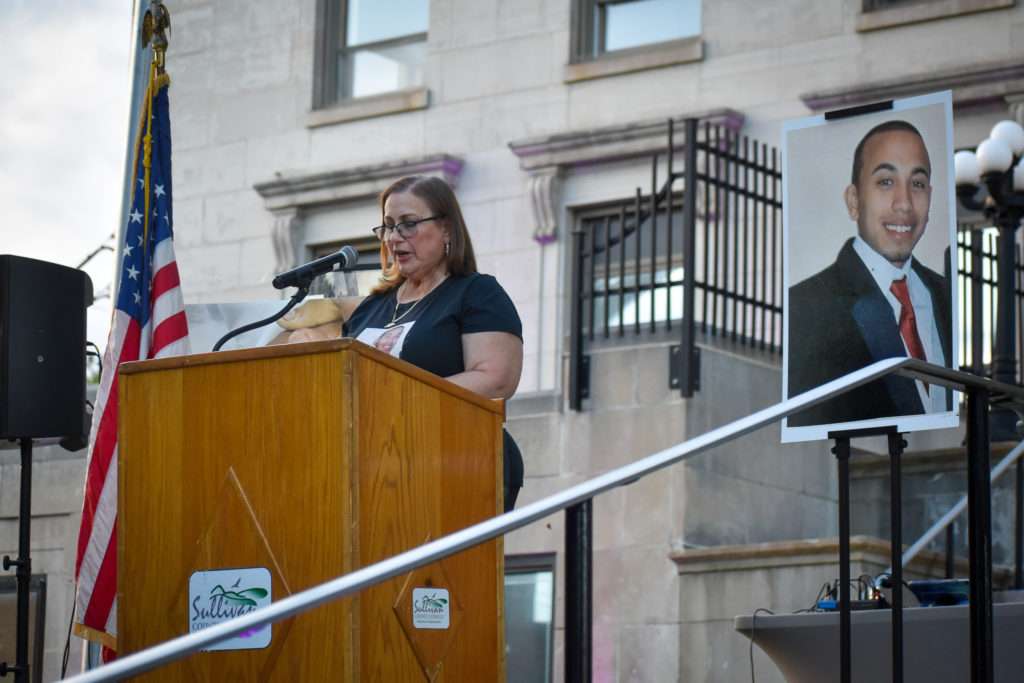 Image: Dorothy Sanchez speaks during a Sullivan 180 International Overdose Awareness Vigil in Monticello, N.Y. in August 2025 (Photo Credit: Sullivan 180)
As local economy falls, the opioid industry thrives
How Sullivan County’s opioid crisis ballooned began nearly a century ago during the Borscht Belt era, said Liddle.
From the 1920s through the 1960s, Jewish Americans opened up as many as 500 hotels in the Catskills after many existing establishments excluded vacationing Jews.
But the region’s tourism changed as the rest of the world opened up. According to the Borscht Belt Historical Marker Project, new affordable airfares to Europe stole crowds of tourists and the draw of the Catskills declined. Most of the resorts closed, and many local businesses filed for bankruptcy by the 1990s.
“There’s automatically an opportunity for drug use to take root in a community like that where there was a functioning industry and perhaps even more so because it was a tourist industry, that the folks that were left behind by the hotels weren’t left with a lot,” said Liddle.
Just as the local economy declined in the 1980s and 1990s, Purdue Pharma released the opioid OxyContin in 1996 and started to aggressively market opioids. “[They] realized that they could make a ton of profit on numbing the pain,” said Liddle. “When you put those things together, it creates a scenario where Sullivan County was doomed. Not for its own fault but just because it was a victim of circumstances.”
In 2010, opioid prescribing peaked. This was also around when local hospital systems were struggling and beginning to consolidate.
The River Reporter details how, in the early 2000s, the county’s community general hospital faced multiple layoff rounds and shrinking healthcare providers. From 2023 to 2025, Sullivan County’s primary healthcare system Garnet Health laid off more than 60 employees to manage ongoing financial constraints and scaled back several outpatient and inpatient services.
READ: Medicaid Cuts Could Be ‘Last Straw’ for Rural Hospitals, Says Garnet Health-Catskills CEO
Despite recent closures to local addiction treatment programs, Liddle says Sullivan County has a trusted network of providers he believes in and whose work is expanding.
The county hosts United Sullivan, a coalition of community-based and health organizations providing resources for substance use treatment and other public health needs. This fall, Lexington Center for Recovery also plans to bring back inpatient services to Sullivan County by opening an inpatient substance use treatment facility at the Garnet Health Harris campus with 47 residential and detox beds.
Still, he’s worried that the federal healthcare cuts from President Trump’s One Big Beautiful Bill could significantly disrupt substance use recovery and treatment programs.
Medicaid remains the largest payer of behavioral services in the country and has ramped up its reimbursement for substance use services. The latest state health department data estimates up to 1.5 million New Yorkers could be stripped of healthcare coverage from the federal bill.
“NARCAN, like I said, is preventing death, but it takes focused, dedicated treatment to really promote life,” said Liddle. “Quite frankly, we’re not optimistic right now.”
Not one but many solutions
Having long-term dedicated care is something that Sanchez says could have helped save her son Jonathan’s life. “We have to have some moral courage to say we are not gonna let people die. We see this: it’s not working.”
She says it’s not going to be just one solution that ends the nation’s opioid epidemic but many.
Sanchez believes a mandated order for treatment is a strategy that could help put people with substance use issues on the path to recovery. More than 30 states already have laws in place for involuntary substance use commitment, but it hasn’t come without pushback.
Sanchez is currently trying to collect signatures for Jonathan’s Legacy, a county bill focused on investing in long-term rehabilitation options for substance use treatment.
Sullivan County’s Substance Use Task Force looks at potential policy solutions like mandated orders and alternatives to incarceration programs such as Hope not Handcuffs, a program to find community-based alternatives for people with substance use addiction.
Part of the solution, Liddle says, has to be community building.
“The only way you defeat a disease of isolation is creating more community,” he said. “There is a balance that needs to be struck in this whole fight of supporting folks in need and punishing those who look to do harm to us. The better we strike that balance, the more likely we are to overcome it in the end.”
If you or someone you know needs help, you can find treatment and support at findtreatment.gov or call the 988 lifeline at 988 24/7. Sullivan 180’s Community Resource Guide has a list of behavior health & mental health providers, housing support, and more in Sullivan County.
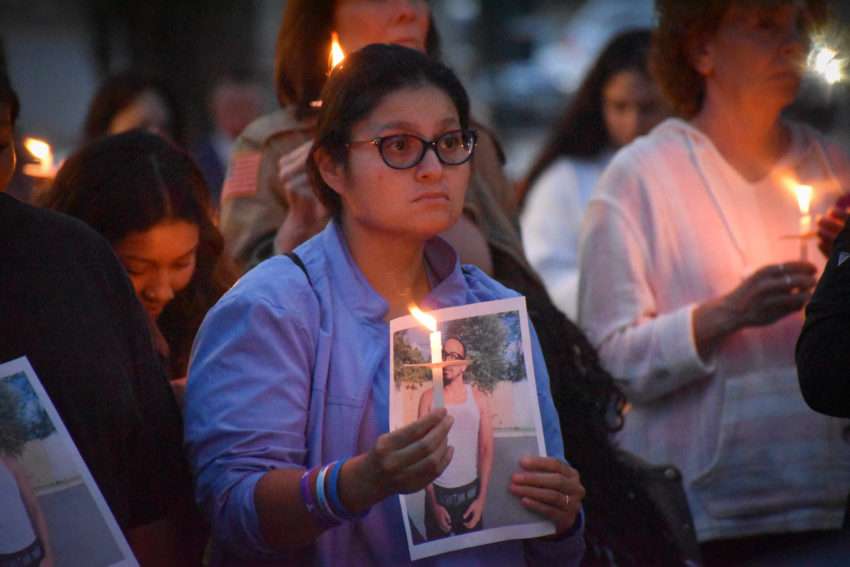
Image: Attendees hold candles and photos of loved ones they lost during Sullivan County’s International Overdose Awareness Vigil in August 2025 (Photo Credit: Sullivan 180)
This was so amazing! I love how it was put together. Bravo Kim!!
I think to solve a problem we have to gather all the data we could get and this story just takes us to one step ahead. Great job – Kimberly Izar !
Arrest is not the answer. It fuels the drug trade. I have been clean for seven years with suboxone. It is the cure. We allow people opinions to slow this. There is a way out, there is hope. It is not easy. Most people don’t know in order to take it, you have to be off fentanyl for at least 3 days.