
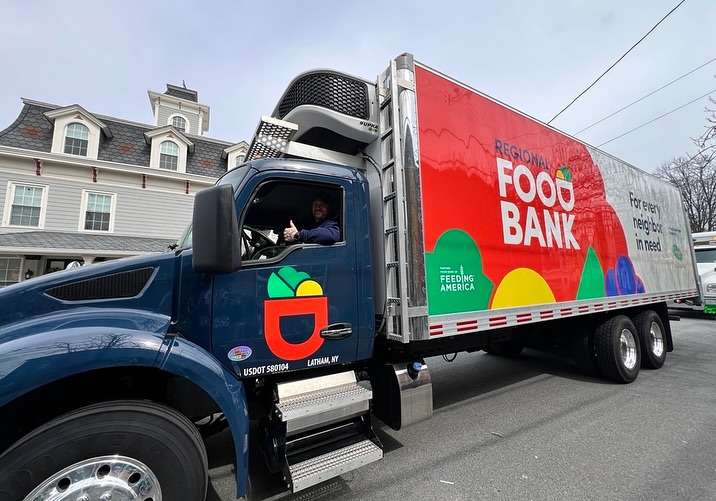
Hunger remains a daily reality for hundreds of thousands of people across the Hudson Valley, even as food banks struggle to keep pace with rising costs and major federal funding cuts.
More than 355,000 people are food insecure across the Regional Food Bank of Northeastern New York’s 23-county service area, according to the organization. In 2025, the food bank distributed roughly the same amount of food as the year before — an outcome leaders describe as remarkable given the loss of hundreds of truckloads of food tied to USDA and SNAP disruptions.
“We had folks who really had no economic means of getting more food, and the food bank had to step up,” said Barry Lewis of the Regional Food Bank. “Through the generosity of donors and community partners, we were able to attempt to offset as best as we can a lot of those cuts.”
Food insecurity rising post-pandemic
Lewis said food insecurity was already increasing before federal cuts took effect, particularly in the Hudson Valley following the pandemic.
“We saw an increase in food insecurity just as the year began,” he said. “In the Hudson Valley alone, we were looking at about an 8% increase.”
In Sullivan County, Lewis noted, one in five children is now considered food insecure.
“That was before SNAP cuts and the shutdown,” he said. “Then suddenly, in the last three months, people had no safety net.”
Across the full service area, Lewis said more than $59 million in monthly SNAP benefits were withheld, representing the loss of roughly 36 million pounds of food per month.
“No food bank would be able to offset that type of cut,” he said. “To put it in perspective, we distribute about 54 million pounds of food in an entire year.”
Community response fills some gaps
Lewis said the crisis led to a broader public understanding of how SNAP works — and how quickly families can fall into need.
“We saw married couples, both working, but finding that the cost of food, utilities and health care were all rising,” he said. “They were turning to food pantries for the first time in their lives.”
The response from the community, he added, was overwhelming.
“It was tremendous to see the outpouring of support this past year,” Lewis said. “People realized their friends, neighbors and family members were being affected, through nothing of their own doing.”
New Montgomery facility expands capacity
One of the most significant developments in 2025 was the opening of the food bank’s $25 million, 50,000-square-foot facility in Montgomery, which Lewis said transformed operations.
“Our previous site didn’t have the storage capacity,” he said. “Food spent more time on trucks and less time in coolers.”
The new facility allows the food bank to store more fresh food, work with additional regional farmers, and distribute healthier options.
“We can provide more fresh fruits and vegetables, more shelf-stable meals, and we can give more to the community,” Lewis said.
He pointed to a recent example through the food bank’s “Shop the Dock” program.
“Just yesterday alone, ShopRite gave us $95,000 in additional inventory,” he said. “Our partners can take whatever fresh food they need, free. That simply wasn’t possible before.”
Volunteers power the mission
The food bank relies on nearly 29,000 volunteers, who contributed more than 72,000 hours of service in 2025.
“If it wasn’t for the volunteers, we’d have to hire more than two dozen full-time staff,” Lewis said.
He said volunteers come from all walks of life — including businesses, banks, schools, hospitals and civic groups.
“We’re seeing CEOs volunteering alongside their employees,” he said. “Schools are bringing in senior classes, and students get a real understanding of the need in their own communities.”
Looking ahead to 2026
As the food bank prepares for 2026, Lewis said the biggest concern remains the potential for additional federal disruptions. A continuing resolution that prevented a government shutdown in 2025 is set to expire Jan. 30, 2026.
“We’re hopeful lawmakers come to an agreement,” Lewis said. “Hunger doesn’t look at political party, religion, age or skin color. It affects everyone.”
Despite the challenges, Lewis said the organization plans to expand programs, including backpack food initiatives, food-as-medicine partnerships with hospitals, and large-scale holiday distributions.
In 2025, the food bank delivered a record 115,000 Thanksgiving meals to 25,000 people, supported by more than 1,000 volunteers.
“Our CEO has pledged we’ll increase that in 2026,” Lewis said.
How to help
Lewis said monetary donations remain the most effective way to support hunger relief.
“For every dollar donated, we can provide about four meals,” he said.
Volunteers are also needed, and community members can find local pantries and programs through the food bank’s website.
More information at regionalfoodbank.net
Image Credit: Regional Food Bank